

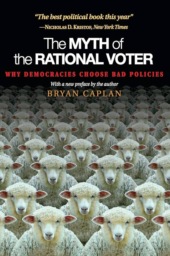
The Myth of the Rational ... (2007)
by Bryan Caplan
If a person has no idea how to get to his destination, he can hardly expect to reach it. He might get lucky, but common sense recognizes a tight connection between knowing what you are doing and successfully doing it. Ubiquitous voter ignorance seems to imply, then, that democracy works poorly. The people ultimately in charge -- the voters -- are doing brain surgery while unable to pass basic anatomy.⏎ There are many sophisticated attempts to spoil this analogy, but the most profound is that democracy can function well under almost any magnitude of voter ignorance. How? Assume that voters do not make systematic errors. Though they err constantly, their errors are random. If voters face a blind choice between X and Y, knowing nothing about them, they are equally likely to choose either.⏎ What happens? With 100% voter ignorance, matters are predictably grim. One candidate could be the Unabomber, plotting to shut down civilization. If voters choose randomly, the Unabomber wins half the time. True, the assumption of zero voter knowledge is overly pessimistic; informed voters are rare, but they do exist. But this seems a small consolation. 100% ignorance leads to disaster. Can 99% ignorance be significantly better?⏎ The surprising answer is yes. The negative effects of voter ignorance are not linear. Democracy with 99% ignorance looks a lot more like democracy with full information than democracy with total ignorance. Why? First, imagine an electorate where 100% of all voters are well informed. Who wins the election? Trivially, whoever has the support of a majority of the well informed. Next, switch to the case where only 1% of voters are well-informed. The other 99% are so thick that they vote at random. Quiz a person waiting to vote, and you are almost sure to conclude, with alarm, that he has no idea what he is doing. Nevertheless, it is basic statistics that -- in a large electorate -- each candidate gets about half of the random votes. Both candidates can bank on roughly a 49.5% share. Yet that is not enough to win. For that, they must focus all their energies on the one well-informed person in a hundred. Who takes the prize? Whoever has the support of a majority of the well informed. The lesson, as Page and Shapiro emphasize, is that studying the average voter is misleading:⏎ "Even if individuals' responses to opinion surveys are partly random, full of measurement error, and unstable, when aggregated into a collective response -- for example, the percentage of people who say they favor a particular policy -- the collective response may be quite meaningful and stable."⏎ Suppose a politician takes a large bribe from "big tobacco" to thumb his nose at unanimous demand for more regulation. Pro-tobacco moves do not hurt the candidate's standing among the ignorant -- they scarcely know his name, much less how he voted. But his share of the informed vote plummets. Things get more complex when the number of issues rises, but the key to success stays the same: Persuade a majority of the well informed to support you.⏎ This result has been aptly named the "Miracle of Aggregation." It reads like an alchemist's recipe: Mix 99 parts folly with 1 part wisdom to get a compound as good as unadulterated wisdom. An almost completely ignorant electorate makes the same decision as a fully informed electorate -- lead into gold, indeed!⏎ It is tempting to call this "voodoo politics," or quip, as H. L. Mencken did, that "democracy is a pathetic belief in the collective wisdom of individual ignorance." But there is nothing magical or pathetic about it. James Surowiecki documents many instances where the Miracle of Aggregation -- or something akin to it -- works as advertised. In a contest to guess the weight of an ox, the average of 787 guesses was off by a single pound. On Who Wants to Be a Millionaire, the answer most popular with studio audiences was correct 91% of the time. Financial markets -- which aggregate the guesses of large numbers of people -- often predict events better than leading experts. Betting odds are excellent predictors of the outcomes of everything from sporting events to elections. In each case, as Page and Shapiro explain, the same logic applies:⏎ "This is just an example of the law of large numbers. Under the right conditions, individual measurement errors will be independently random and will tend to cancel each other out. Errors in one direction will tend to offset errors in the opposite direction."⏎ When defenders of democracy first encounter rational ignorance, they generally grant that severe voter ignorance would hobble government by the people. Their instinctive responses are to (a) deny that voters are disturbingly ignorant, or (b) interpret voters' ignorance as a fragile, temporary condition. To call these responses "empirically vulnerable" is charitable. Decades of research show they are plain wrong. About half of Americans do not know that each state has two senators, and three-quarters do not know the length of their terms. About 70% can say which party controls the House, and 60% which party controls the Senate. Over half cannot name their congressman, and 40% cannot name either of their senators. Slightly lower percentages know their representatives' party affiliations. Furthermore, these low knowledge levels have been stable since the dawn of polling, and international comparisons reveal Americans' overall political knowledge to be no more than moderately below average.⏎ You could insist that none of this information is relevant. Perhaps voters have holistic insight that defies measurement. But this is a desperate route for a defender of democracy to take. The Miracle of Aggregation provides a more secure foundation for democracy. It lets people believe in empirical evidence and democracy at the same time.⏎ The original arguments about rational ignorance took time to spread, but eventually became conventional wisdom. The Miracle of Aggregation is currently in the middle of a similar diffusion process. Some have yet to hear of the Miracle. Backward-looking thinkers hope that if they ignore the objection, it will go away. But the logic is too compelling. Unless someone uncovers a flaw in the Miracle, the fault line in the social sciences will close. Economists and economically minded political scientists and law professors will rethink their doubts about democracy, and go back to the prerational ignorance presumption that if democracies do X, X is a good idea.🏁
Global Leaderboard
| # | Player | Time | Duration | Accuracy | WPM | pp | ||
|---|---|---|---|---|---|---|---|---|
| 1 | ||||||||
| 2 | ||||||||
| 3 | ||||||||
| 4 | ||||||||
| 5 | ||||||||
| 6 | ||||||||
| 7 | ||||||||
| 8 | ||||||||
| 9 | ||||||||
| 10 |
If a person has no idea how to get to his destination, he can hardly expect to reach it. He might get lucky, but common sense recognizes a tight connection between knowing what you are doing and successfully doing it. Ubiquitous voter ignorance seems to imply, then, that democracy works poorly. The people ultimately in charge -- the voters -- are doing brain surgery while unable to pass basic anatomy.⏎ There are many sophisticated attempts to spoil this analogy, but the most profound is that democracy can function well under almost any magnitude of voter ignorance. How? Assume that voters do not make systematic errors. Though they err constantly, their errors are random. If voters face a blind choice between X and Y, knowing nothing about them, they are equally likely to choose either.⏎ What happens? With 100% voter ignorance, matters are predictably grim. One candidate could be the Unabomber, plotting to shut down civilization. If voters choose randomly, the Unabomber wins half the time. True, the assumption of zero voter knowledge is overly pessimistic; informed voters are rare, but they do exist. But this seems a small consolation. 100% ignorance leads to disaster. Can 99% ignorance be significantly better?⏎ The surprising answer is yes. The negative effects of voter ignorance are not linear. Democracy with 99% ignorance looks a lot more like democracy with full information than democracy with total ignorance. Why? First, imagine an electorate where 100% of all voters are well informed. Who wins the election? Trivially, whoever has the support of a majority of the well informed. Next, switch to the case where only 1% of voters are well-informed. The other 99% are so thick that they vote at random. Quiz a person waiting to vote, and you are almost sure to conclude, with alarm, that he has no idea what he is doing. Nevertheless, it is basic statistics that -- in a large electorate -- each candidate gets about half of the random votes. Both candidates can bank on roughly a 49.5% share. Yet that is not enough to win. For that, they must focus all their energies on the one well-informed person in a hundred. Who takes the prize? Whoever has the support of a majority of the well informed. The lesson, as Page and Shapiro emphasize, is that studying the average voter is misleading:⏎ "Even if individuals' responses to opinion surveys are partly random, full of measurement error, and unstable, when aggregated into a collective response -- for example, the percentage of people who say they favor a particular policy -- the collective response may be quite meaningful and stable."⏎ Suppose a politician takes a large bribe from "big tobacco" to thumb his nose at unanimous demand for more regulation. Pro-tobacco moves do not hurt the candidate's standing among the ignorant -- they scarcely know his name, much less how he voted. But his share of the informed vote plummets. Things get more complex when the number of issues rises, but the key to success stays the same: Persuade a majority of the well informed to support you.⏎ This result has been aptly named the "Miracle of Aggregation." It reads like an alchemist's recipe: Mix 99 parts folly with 1 part wisdom to get a compound as good as unadulterated wisdom. An almost completely ignorant electorate makes the same decision as a fully informed electorate -- lead into gold, indeed!⏎ It is tempting to call this "voodoo politics," or quip, as H. L. Mencken did, that "democracy is a pathetic belief in the collective wisdom of individual ignorance." But there is nothing magical or pathetic about it. James Surowiecki documents many instances where the Miracle of Aggregation -- or something akin to it -- works as advertised. In a contest to guess the weight of an ox, the average of 787 guesses was off by a single pound. On Who Wants to Be a Millionaire, the answer most popular with studio audiences was correct 91% of the time. Financial markets -- which aggregate the guesses of large numbers of people -- often predict events better than leading experts. Betting odds are excellent predictors of the outcomes of everything from sporting events to elections. In each case, as Page and Shapiro explain, the same logic applies:⏎ "This is just an example of the law of large numbers. Under the right conditions, individual measurement errors will be independently random and will tend to cancel each other out. Errors in one direction will tend to offset errors in the opposite direction."⏎ When defenders of democracy first encounter rational ignorance, they generally grant that severe voter ignorance would hobble government by the people. Their instinctive responses are to (a) deny that voters are disturbingly ignorant, or (b) interpret voters' ignorance as a fragile, temporary condition. To call these responses "empirically vulnerable" is charitable. Decades of research show they are plain wrong. About half of Americans do not know that each state has two senators, and three-quarters do not know the length of their terms. About 70% can say which party controls the House, and 60% which party controls the Senate. Over half cannot name their congressman, and 40% cannot name either of their senators. Slightly lower percentages know their representatives' party affiliations. Furthermore, these low knowledge levels have been stable since the dawn of polling, and international comparisons reveal Americans' overall political knowledge to be no more than moderately below average.⏎ You could insist that none of this information is relevant. Perhaps voters have holistic insight that defies measurement. But this is a desperate route for a defender of democracy to take. The Miracle of Aggregation provides a more secure foundation for democracy. It lets people believe in empirical evidence and democracy at the same time.⏎ The original arguments about rational ignorance took time to spread, but eventually became conventional wisdom. The Miracle of Aggregation is currently in the middle of a similar diffusion process. Some have yet to hear of the Miracle. Backward-looking thinkers hope that if they ignore the objection, it will go away. But the logic is too compelling. Unless someone uncovers a flaw in the Miracle, the fault line in the social sciences will close. Economists and economically minded political scientists and law professors will rethink their doubts about democracy, and go back to the prerational ignorance presumption that if democracies do X, X is a good idea.🏁