

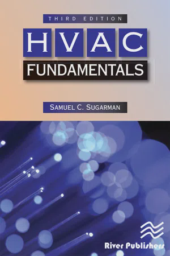
HVAC Fundamentals: Third Edition (2020)
by Samuel C. Sugarman
Properly designed, installed, tested and maintained heating, ventilating and air conditioning (HVAC) systems provide conditioned air for the work process function, occupancy comfort, and good indoor air quality while keeping system costs and energy requirements to a minimum. Commercial HVAC systems provide building work areas with "conditioned air" so that occupants will have a comfortable and safe work environment. People respond to their work environment in many ways and many factors affect their health, attitude and productivity. "Air quality" and the "condition of the air" are two very important factors. "Conditioned air" and "good air quality," means that air should be clean and odor-free and the temperature, humidity, and movement of the air is within certain acceptable comfort ranges. ASHRAE, the American Society of Heating, Refrigerating and Air Conditioning Engineers, has established standards which outline indoor comfort conditions that are thermally acceptable to 80% or more of a commercial building's occupants. Generally, these comfort conditions, sometimes called the "comfort zone," are between 68F and 75F for winter and 73F to 78F during the summer. Both these ranges are for room air at approximately 50% relative humidity and moving at a slow speed (velocity) of 30 feet per minute or less. The HVAC system is simply a group of components working together to provide heat to, or remove heat from, a conditioned space. For example the components in a typical roof-mounted package unit HVAC system are: 1. An indoor fan (aka blower) to circulate the supply and return air. 2. Supply air ductwork in which the air flows from the fan to the conditioned space. 3. Air devices such as supply air outlets and return air inlets. 4. Return air ductwork in which the air flows back from the conditioned space to the unit. 5. A mixed air chamber (aka mixed air plenum) to receive the return air and mix it with outside air. 6. An outside air device such as a louver, screened opening or duct to allow for the entrance of outside air into the mixed air plenum. 7. A filter section to remove dirt, debris and dust particles from the air. 8. Heat exchangers such as a refrigerant evaporator coil and condenser coil for cooling, and a furnace for heating. 9. A compressor to compress the refrigerant vapor and pump the refrigerant around the refrigeration system. 10. An outdoor fan (aka blower) to circulate outside air across the aircooled condenser coil. 11. Controls to start, stop and regulate the flow of air, refrigerant, and electricity.🏁
Global Leaderboard
| # | Player | Time | Duration | Accuracy | WPM | pp | ||
|---|---|---|---|---|---|---|---|---|
| 1 | ||||||||
| 2 | ||||||||
| 3 | ||||||||
| 4 | ||||||||
| 5 | ||||||||
| 6 | ||||||||
| 7 | ||||||||
| 8 | ||||||||
| 9 | ||||||||
| 10 |
Properly designed, installed, tested and maintained heating, ventilating and air conditioning (HVAC) systems provide conditioned air for the work process function, occupancy comfort, and good indoor air quality while keeping system costs and energy requirements to a minimum. Commercial HVAC systems provide building work areas with "conditioned air" so that occupants will have a comfortable and safe work environment. People respond to their work environment in many ways and many factors affect their health, attitude and productivity. "Air quality" and the "condition of the air" are two very important factors. "Conditioned air" and "good air quality," means that air should be clean and odor-free and the temperature, humidity, and movement of the air is within certain acceptable comfort ranges. ASHRAE, the American Society of Heating, Refrigerating and Air Conditioning Engineers, has established standards which outline indoor comfort conditions that are thermally acceptable to 80% or more of a commercial building's occupants. Generally, these comfort conditions, sometimes called the "comfort zone," are between 68F and 75F for winter and 73F to 78F during the summer. Both these ranges are for room air at approximately 50% relative humidity and moving at a slow speed (velocity) of 30 feet per minute or less. The HVAC system is simply a group of components working together to provide heat to, or remove heat from, a conditioned space. For example the components in a typical roof-mounted package unit HVAC system are: 1. An indoor fan (aka blower) to circulate the supply and return air. 2. Supply air ductwork in which the air flows from the fan to the conditioned space. 3. Air devices such as supply air outlets and return air inlets. 4. Return air ductwork in which the air flows back from the conditioned space to the unit. 5. A mixed air chamber (aka mixed air plenum) to receive the return air and mix it with outside air. 6. An outside air device such as a louver, screened opening or duct to allow for the entrance of outside air into the mixed air plenum. 7. A filter section to remove dirt, debris and dust particles from the air. 8. Heat exchangers such as a refrigerant evaporator coil and condenser coil for cooling, and a furnace for heating. 9. A compressor to compress the refrigerant vapor and pump the refrigerant around the refrigeration system. 10. An outdoor fan (aka blower) to circulate outside air across the aircooled condenser coil. 11. Controls to start, stop and regulate the flow of air, refrigerant, and electricity.🏁