

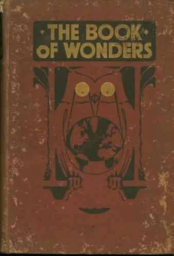
The Book of Wonders: Give... (1915)
by Rudolph John Bodmer
The sand on the seashore is nothing more or less than ground-up sandstone. In dealing with the inanimate things in the world we find that a very important element of all of them has been given the name silicon. When the crust of the earth, which is the part we call the land and rocks, and includes the part under the sea, was a molten mass, this silicon was burned, combining with the oxygen which surrounded everything, and produced what is known as silica. Silica is the name given to the thing which is left after you burn silicon. A very large part of this silica was deposited in parts of the earth, and when the crust of the earth cooled off it was sand. By pressure and contact with other substances it became stuck together, just as you can take wet sand at the seashore to-day and make bricks and houses and tunnels, excepting that in the case we speak of it was something besides water that pressed and stuck the little particles of sand together. They stuck together more permanently. Then when the oceans were formed, as shown in another part of this book, much of the sandstone was found to be at the bottom and on the shores of the oceans. The action of the water continually washing against the sandstone gradually broke the sandstone up into the tiny particles of sand again, and this is what makes the sand on the seashore.🏁
Global Leaderboard
| # | Player | Time | Duration | Accuracy | WPM | pp | ||
|---|---|---|---|---|---|---|---|---|
| 1 | ||||||||
| 2 | ||||||||
| 3 | ||||||||
| 4 | ||||||||
| 5 | ||||||||
| 6 | ||||||||
| 7 | ||||||||
| 8 | ||||||||
| 9 | ||||||||
| 10 |
The sand on the seashore is nothing more or less than ground-up sandstone. In dealing with the inanimate things in the world we find that a very important element of all of them has been given the name silicon. When the crust of the earth, which is the part we call the land and rocks, and includes the part under the sea, was a molten mass, this silicon was burned, combining with the oxygen which surrounded everything, and produced what is known as silica. Silica is the name given to the thing which is left after you burn silicon. A very large part of this silica was deposited in parts of the earth, and when the crust of the earth cooled off it was sand. By pressure and contact with other substances it became stuck together, just as you can take wet sand at the seashore to-day and make bricks and houses and tunnels, excepting that in the case we speak of it was something besides water that pressed and stuck the little particles of sand together. They stuck together more permanently. Then when the oceans were formed, as shown in another part of this book, much of the sandstone was found to be at the bottom and on the shores of the oceans. The action of the water continually washing against the sandstone gradually broke the sandstone up into the tiny particles of sand again, and this is what makes the sand on the seashore.🏁