
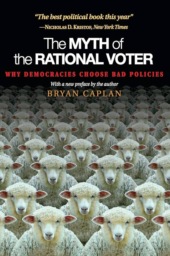
The Myth of the Rational ... (2007)
by Bryan Caplan
What voters don't know would fill a university library. In the last few decades, economists who study politics have revitalized age-old worries about the people's competence to govern by pointing out that-selfishly speaking-voters are not making a mistake. One vote has so small a probability of affecting electoral outcomes that a realistic egoist pays no attention to politics; he chooses to be, in economic jargon, rationally ignorant.⏎ For those who worship at the temple of democracy, this economic argument adds insult to injury. It is bad enough that voters happen to know so little. It remains bearable, though, as long as the electorate's ignorance is a passing phase. Pundits often blame citizens' apathy on an elections' exceptionally insipid candidates. Deeper thinkers, who notice that the apathy persists year after year, blame voters' ignorance on lack of democracy itself. Robert Kuttner spells out one version of the story:⏎ "The essence of political democracy-the franchise-has eroded, as voting and face-to-face politics give way to campaign-finance plutocracy... here is a direct connection between the domination of politics by special interest money, paid attack ads, strategies driven by polling and focus groups-and the desertion of citizens... People conclude that politics is something that excludes them."⏎ Yet the slogan "The solution for the problems of democracy is more democracy" sounds hollow after you digest the idea of rational ignorance. Voter ignorance is a product of natural human selfishness, not a transient cultural aberration. It is hard to see how initiatives, or campaign finance reform, or any of the popular ways to "fix democracy" strengthen voters' incentive to inform themselves.⏎ As the rational ignorance insight spread, it became an intellectual fault line in the social sciences. Economists, along with economically minded political scientists and law professors, are generally on one side of the fault line. They see voter ignorance as a serious problem, making them skeptical about using government intervention to improve market outcomes. Beneficial government action is possible in theory, but how could hopelessly uninformed voters be expected to elect politicians who follow through? The implication: "Voters don't know what they're doing; just leave it to the market." Thinkers on the other side of the fault line downplay these doubts about government intervention. Once you discount the problem of voter ignorance, it is a short hop from "the policies beneficial in theory" to "the policies democracies adopt in practice."⏎ In time, rational ignorance spawned an expansive research program, known as public choice or political economy or rational choice theory. In the 1960s, finding fault with democracy bordered on heretical, but the approach was hearty enough to take root. Critiques of foolish government policies multiplied during the 1970s, paving the way for deregulation and privatization.⏎ But as these ideas started to change the world, serious challenges to their intellectual foundations surfaced. Earlier criticism often came from thinkers with little understanding of, and less sympathy for, the economic way of thinking. The new doubts were framed in clear economic logic.🏁
Global Leaderboard
| # | Player | Time | Duration | Accuracy | WPM | pp | ||
|---|---|---|---|---|---|---|---|---|
| 1 | ||||||||
| 2 | ||||||||
| 3 | ||||||||
| 4 | ||||||||
| 5 | ||||||||
| 6 | ||||||||
| 7 | ||||||||
| 8 | ||||||||
| 9 | ||||||||
| 10 |
What voters don't know would fill a university library. In the last few decades, economists who study politics have revitalized age-old worries about the people's competence to govern by pointing out that-selfishly speaking-voters are not making a mistake. One vote has so small a probability of affecting electoral outcomes that a realistic egoist pays no attention to politics; he chooses to be, in economic jargon, rationally ignorant.⏎ For those who worship at the temple of democracy, this economic argument adds insult to injury. It is bad enough that voters happen to know so little. It remains bearable, though, as long as the electorate's ignorance is a passing phase. Pundits often blame citizens' apathy on an elections' exceptionally insipid candidates. Deeper thinkers, who notice that the apathy persists year after year, blame voters' ignorance on lack of democracy itself. Robert Kuttner spells out one version of the story:⏎ "The essence of political democracy-the franchise-has eroded, as voting and face-to-face politics give way to campaign-finance plutocracy... here is a direct connection between the domination of politics by special interest money, paid attack ads, strategies driven by polling and focus groups-and the desertion of citizens... People conclude that politics is something that excludes them."⏎ Yet the slogan "The solution for the problems of democracy is more democracy" sounds hollow after you digest the idea of rational ignorance. Voter ignorance is a product of natural human selfishness, not a transient cultural aberration. It is hard to see how initiatives, or campaign finance reform, or any of the popular ways to "fix democracy" strengthen voters' incentive to inform themselves.⏎ As the rational ignorance insight spread, it became an intellectual fault line in the social sciences. Economists, along with economically minded political scientists and law professors, are generally on one side of the fault line. They see voter ignorance as a serious problem, making them skeptical about using government intervention to improve market outcomes. Beneficial government action is possible in theory, but how could hopelessly uninformed voters be expected to elect politicians who follow through? The implication: "Voters don't know what they're doing; just leave it to the market." Thinkers on the other side of the fault line downplay these doubts about government intervention. Once you discount the problem of voter ignorance, it is a short hop from "the policies beneficial in theory" to "the policies democracies adopt in practice."⏎ In time, rational ignorance spawned an expansive research program, known as public choice or political economy or rational choice theory. In the 1960s, finding fault with democracy bordered on heretical, but the approach was hearty enough to take root. Critiques of foolish government policies multiplied during the 1970s, paving the way for deregulation and privatization.⏎ But as these ideas started to change the world, serious challenges to their intellectual foundations surfaced. Earlier criticism often came from thinkers with little understanding of, and less sympathy for, the economic way of thinking. The new doubts were framed in clear economic logic.🏁