
#6
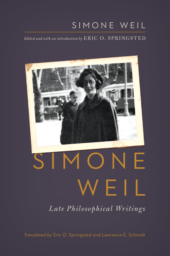
Simone Weil: Late Philosophical Writings (2015)
by Book Grief & Loss
Submitted by
S
semi 
1714c 5.28
Ranked
Simone Weil: Late Philosophical Writings
by Simone Weil
⇥ The mystery is that there are sensations that are pretty much insignificant in themselves, yet, by what they signify, what they mean, they seize us in the same way as the stronger sensations. There are some black marks on a sheet of white paper; they couldn't differ more from a punch in the stomach. Yet, they can have the same effect. We have all experienced, to a greater or lesser degree, the effect of bad news that we have read in a letter or newspaper. Before we have fully taken account of what is going on, we feel ourselves seized and thrown down just as if we had been hit; even much later the sight of the letter remains painful. Sometimes, when time has lessened the pain a bit, one is shuffling through papers and suddenly the letter jumps out, an even more stabbing pain surfaces, just as piercing as any physical pain, seizing us as if it came from outside ourselves and as if the letter itself were on fire. Two women each receive a letter saying that her son is dead. The first one glances at it, faints, and until the day she dies her eyes, her mouth, and her movements will never be the same. The second one remains unmoved; her face, her posture does not change at all: she doesn't know how to read. It isn't the sensation, it is the meaning that has seized the first woman by striking her mind, immediately, as a brute fact, without her participation in the matter, just the way that sensations strike us. Everything happens as if the pain were in the letter itself, and jumped out from the letter to land on the face reading it. With respect to the actual sensations themselves - the color of the paper or the ink - they do not even come to mind. It is the pain that is given to one's sight.🏁
Submitted by semi - 06/02/2026
Book Grief & Loss 5.28 Ranked
Global Leaderboard
| # | Player | Time | Duration | Accuracy | WPM | pp | ||
|---|---|---|---|---|---|---|---|---|
| 1 | ||||||||
| 2 | ||||||||
| 3 | ||||||||
| 4 | ||||||||
| 5 | ||||||||
| 6 | ||||||||
| 7 | ||||||||
| 8 | ||||||||
| 9 | ||||||||
| 10 |
Simone Weil: Late Philosophical Writings
by Simone Weil
⇥ The mystery is that there are sensations that are pretty much insignificant in themselves, yet, by what they signify, what they mean, they seize us in the same way as the stronger sensations. There are some black marks on a sheet of white paper; they couldn't differ more from a punch in the stomach. Yet, they can have the same effect. We have all experienced, to a greater or lesser degree, the effect of bad news that we have read in a letter or newspaper. Before we have fully taken account of what is going on, we feel ourselves seized and thrown down just as if we had been hit; even much later the sight of the letter remains painful. Sometimes, when time has lessened the pain a bit, one is shuffling through papers and suddenly the letter jumps out, an even more stabbing pain surfaces, just as piercing as any physical pain, seizing us as if it came from outside ourselves and as if the letter itself were on fire. Two women each receive a letter saying that her son is dead. The first one glances at it, faints, and until the day she dies her eyes, her mouth, and her movements will never be the same. The second one remains unmoved; her face, her posture does not change at all: she doesn't know how to read. It isn't the sensation, it is the meaning that has seized the first woman by striking her mind, immediately, as a brute fact, without her participation in the matter, just the way that sensations strike us. Everything happens as if the pain were in the letter itself, and jumped out from the letter to land on the face reading it. With respect to the actual sensations themselves - the color of the paper or the ink - they do not even come to mind. It is the pain that is given to one's sight.🏁
Submitted by semi - 06/02/2026
Book Grief & Loss 5.28 Ranked