Welcome to the Alpha build of TypeGG! For the best user experience, we recommend playing
with an account. Login


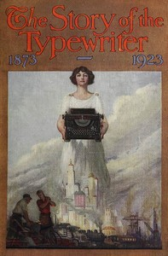
The Story of the Typewriter
by Herkimer County Historical Society
In due time the machine arrived in Chicago, and Porter thus describes the demonstration which followed. "A sounder and key were placed upon the table and General Stager was the first to manipulate the same for me to copy, which I did readily. Colonel Lynch then attempted to 'rush' me, and failing to do so, an 'expert' sender was sent for from the operating room. A thorough trial of my ability to 'keep up' resulted so satisfactorily that the typewriter was taken into the operating room."⏎ ⏎ This demonstration was made in the year 1869, and Porter's description of it gives the whole gist of typewriting in its relation to telegraphy. It lies simply in the superior speed of the "mill," as telegraphers call the typewriter, over handwriting, in receiving over the wire, and it is just this difference in speed which in the past forty years has revolutionized the telegrapher's profession. The partnership between telegraphy and the "mill" is as firmly established today as that other partnership between the typewriter and shorthand, and it is worth noting that, in each case, the reality of this partnership was demonstrated at least five years before the first typewriter was actually placed on the market.⏎ ⏎ The mention of telegraphy brings another name into this story, that of no less a personage than Thomas A. Edison. It has been said of this universal inventive genius that he has figured in some way in connection with nearly every development in the field of mechanical progress during the last half century; so it is not surprising to find his name written into the story of the typewriter. Early in the seventies Edison had a shop in Newark, N. J., and he tells how Sholes came there to consult with him concerning his invention; a natural thing for Sholes to do, for even in those early days the fame of "The Wizard" was nation-wide. Edison was able to give Sholes some very valuable assistance. Later on, Edison helped D. W. Craig, a former general manager of the Associated Press, in the development of a machine, built on typewriter principles, designed to facilitate the transmission of telegrams. Edison also did some typewriter inventing on his own account. His patent of December 10, 1872, is for an electrically operated traveling wheel device, which was the forerunner of the stock-ticker printing machine in use today.⏎ ⏎ Of the twenty-five to thirty experimental models, built by Sholes and Glidden during the years from 1867 to 1873, only a few are now in existence. But though many links in this chain are missing, it is fortunate that the two most important ones are still preserved, the first and the last. The first model constructed by Sholes, Soule and Glidden, now in the Smithsonian Institution at Washington (Patent of June 23, 1868), shows a machine so crude that it would hardly be recognized as a typewriter. A second model, also in the Smithsonian Institution (Patent of July 14, 1868), is of equal interest because it has been identified by Weller as identical with the first machine sent to him by Sholes for practical testing. This machine shows a great advance over the other. Both machines, however, have the up-strike pivoted type bar, a feature which afterwards became standard for many years in typewriter construction. The last model of the long series was the one shown to the Remingtons in 1873, when the contract was made for the manufacture of the typewriter. This model, now in the historical collection at the home office of the Remington Typewriter Company in New York, although a crude affair, judged by present-day standards, contains many of the fundamental features of the modern type-bar machines.⏎ ⏎ The quality of the writing done by these early models is better known today than the machines themselves, for this writing has been preserved to us in Sholes's own letters. From the day when Sholes completed his first model, he seems to have discarded the pen entirely. From that time all his personal letters are typewritten, the signature included, which would be considered extreme, even by the present-day business man. As for the quality of the typing in these letters, let it speak for itself. The letter shown on page 51, the original of which is in the Remington Historical Collection, was written by Sholes from Milwaukee on June 9, 1872.⏎ ⏎ The typing in this letter is interesting because it shows capital letters only, to which all the Sholes models were restricted. But even more interesting is the contents of the letter itself, for in it we find Sholes in one of his not infrequent fits of deep despondency.🏁
Submitted by Dasha - 12/18/2025
Book Non-Fiction 6.34 Ranked
Global Leaderboard
| # | Player | Time | Duration | Accuracy | WPM | pp | ||
|---|---|---|---|---|---|---|---|---|
| 1 | ||||||||
| 2 | ||||||||
| 3 | ||||||||
| 4 | ||||||||
| 5 | ||||||||
| 6 | ||||||||
| 7 | ||||||||
| 8 | ||||||||
| 9 | ||||||||
| 10 |
The Story of the Typewriter
by Herkimer County Historical Society
In due time the machine arrived in Chicago, and Porter thus describes the demonstration which followed. "A sounder and key were placed upon the table and General Stager was the first to manipulate the same for me to copy, which I did readily. Colonel Lynch then attempted to 'rush' me, and failing to do so, an 'expert' sender was sent for from the operating room. A thorough trial of my ability to 'keep up' resulted so satisfactorily that the typewriter was taken into the operating room."⏎ ⏎ This demonstration was made in the year 1869, and Porter's description of it gives the whole gist of typewriting in its relation to telegraphy. It lies simply in the superior speed of the "mill," as telegraphers call the typewriter, over handwriting, in receiving over the wire, and it is just this difference in speed which in the past forty years has revolutionized the telegrapher's profession. The partnership between telegraphy and the "mill" is as firmly established today as that other partnership between the typewriter and shorthand, and it is worth noting that, in each case, the reality of this partnership was demonstrated at least five years before the first typewriter was actually placed on the market.⏎ ⏎ The mention of telegraphy brings another name into this story, that of no less a personage than Thomas A. Edison. It has been said of this universal inventive genius that he has figured in some way in connection with nearly every development in the field of mechanical progress during the last half century; so it is not surprising to find his name written into the story of the typewriter. Early in the seventies Edison had a shop in Newark, N. J., and he tells how Sholes came there to consult with him concerning his invention; a natural thing for Sholes to do, for even in those early days the fame of "The Wizard" was nation-wide. Edison was able to give Sholes some very valuable assistance. Later on, Edison helped D. W. Craig, a former general manager of the Associated Press, in the development of a machine, built on typewriter principles, designed to facilitate the transmission of telegrams. Edison also did some typewriter inventing on his own account. His patent of December 10, 1872, is for an electrically operated traveling wheel device, which was the forerunner of the stock-ticker printing machine in use today.⏎ ⏎ Of the twenty-five to thirty experimental models, built by Sholes and Glidden during the years from 1867 to 1873, only a few are now in existence. But though many links in this chain are missing, it is fortunate that the two most important ones are still preserved, the first and the last. The first model constructed by Sholes, Soule and Glidden, now in the Smithsonian Institution at Washington (Patent of June 23, 1868), shows a machine so crude that it would hardly be recognized as a typewriter. A second model, also in the Smithsonian Institution (Patent of July 14, 1868), is of equal interest because it has been identified by Weller as identical with the first machine sent to him by Sholes for practical testing. This machine shows a great advance over the other. Both machines, however, have the up-strike pivoted type bar, a feature which afterwards became standard for many years in typewriter construction. The last model of the long series was the one shown to the Remingtons in 1873, when the contract was made for the manufacture of the typewriter. This model, now in the historical collection at the home office of the Remington Typewriter Company in New York, although a crude affair, judged by present-day standards, contains many of the fundamental features of the modern type-bar machines.⏎ ⏎ The quality of the writing done by these early models is better known today than the machines themselves, for this writing has been preserved to us in Sholes's own letters. From the day when Sholes completed his first model, he seems to have discarded the pen entirely. From that time all his personal letters are typewritten, the signature included, which would be considered extreme, even by the present-day business man. As for the quality of the typing in these letters, let it speak for itself. The letter shown on page 51, the original of which is in the Remington Historical Collection, was written by Sholes from Milwaukee on June 9, 1872.⏎ ⏎ The typing in this letter is interesting because it shows capital letters only, to which all the Sholes models were restricted. But even more interesting is the contents of the letter itself, for in it we find Sholes in one of his not infrequent fits of deep despondency.🏁
Submitted by Dasha - 12/18/2025
Book Non-Fiction 6.34 Ranked